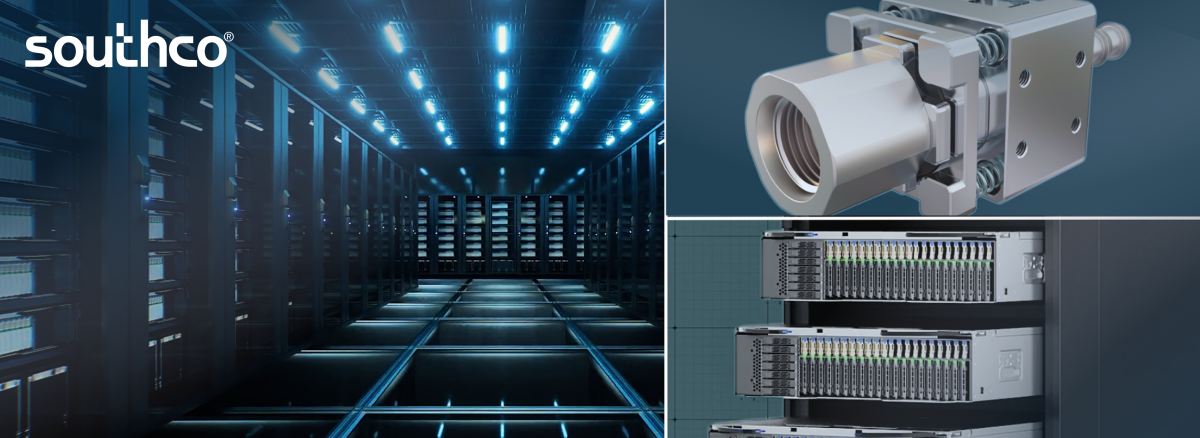
Global computing power is growing and pushing high-density chip power consumption. As power density increases, traditional air cooling faces limitations, while liquid cooling technology, which offers higher thermal efficiency than air cooling, is becoming increasingly adopted in data centre infrastructure.
Driven by global sustainability targets and the need for high-performance, energy-efficient infrastructures, new large data centres must achieve their targeted PUE values, accelerating the industry towards large-scale liquid cooling. However, reliability issues stemming from insufficient mechanical tolerances at the connection points of liquid cooling systems are becoming a critical bottleneck for energy efficiency upgrades and stable operation. Southco recognises the severity of this challenge and is committed to providing solutions.
Minor Deviations, Major Costs
During the large-scale deployment of liquid cooling technology, the reliability of connection interfaces is vital. According to key data from the Open Compute Project (OCP) "Rack-Mounted Manifold Requirements and Verification Guidelines," a mere 1mm increase in mechanical deviation at liquid cooling interfaces can significantly raise system flow resistance by 15%, leading to a 7% increase in pump energy consumption. This is no trivial amount; in a hyperscale data centre with thousands of interfaces, it translates to millions of kilowatt-hours of additional energy consumption and substantial operational costs each year. More concerning is that traditional rigid connection solutions typically offer only ±0.5mm of static tolerance, which proves inadequate in complex real-world environments like these:
• Accumulation of Multi-Dimensional Installation Deviations: In mixed deployment scenarios of widely used EIA-310-D standard racks and advanced ORV3 open architectures, rack installation tolerances can accumulate up to ±3.2mm, exceeding the limits of traditional solutions.
• Dynamic Vibration Impacts: In ISTA 3-E vibration tests simulating real transportation and operating environments, interface displacement often exceeds 2.8mm, posing significant risks of leaks or connection failures.
• Material Thermal Expansion Effects: Under a typical temperature change of 55°C, copper alloy manifolds can expand approximately 1.2mm per meter, continuously challenging fixed interfaces.
These dynamic, multi-dimensional deviations underline the urgent need for an intelligent, reliable sealing connection solution to ensure the long-term, efficient, and safe operation of liquid cooling systems.
Blind Mate Quick Disconnect: A Connection for a Dynamic World
Southco aims to confront this challenge head-on with the launch of "Blind Mate Floating Mechanism" liquid cooling connection solution. This is not just a new product; it is a systematic response to insight into industry pain points.
Current Status and Trends of Blind Mate Floating Technology
Liquid cooling technology is rapidly gaining traction in high-performance computing (HPC), AI training clusters, and hyperscale data centres. Blind mate technology allows devices to connect without precise visual alignment, making it a core interface solution for rapid deployment and efficient maintenance in liquid cooling systems (especially cold plate systems). The development trends are clear:
1. Higher Tolerance Capacity: Adapting to more complex rack environments and dynamic changes is essential.
2. Increased Reliability: Zero leakage, long lifespan, and resistance to extreme conditions are basic requirements.
3. Intelligent Integration: Integrating sensors for flow, temperature, pressure, etc., for real-time monitoring and predictive maintenance is a future direction.
4. Standardisation and Compatibility: Supporting OCP ORV3 and other open standards for seamless integration across platforms and manufacturers.
Standard ISO 11926-1 threaded interface design, compatible with OCP UQD/UQDB connectors, and custom designs are available.
5. Lightweight and Compact Design: Meeting the demands of higher density deployments.
Southco's Blind Mate Floating Mechanism exemplifies the design centred around these core trends.
Advantages Over Traditional Solutions
Compared to traditional fixed or simple floating heat transfer connection solutions, Southco's "Blind Mate Floating Mechanism" offers advantages evident across multiple dimensions.
• Three-Dimensional Dynamic Tolerance Control: Southco’s design features a three-dimensional dynamic compensation mechanism: ±4mm of floating tolerance in the radial direction (2° tilt compensation) and 6mm of displacement absorption capacity in the axial direction. This exceeds common static tolerances in the industry, effectively absorbing and adapting to all previously mentioned installation tolerances, vibration displacements, and thermal expansion deformations.
• Self-Centring Mechanism: When the liquid-cooled blind-plug connector is unplugged, the floating structure automatically resets to the centre position, ensuring sufficient floating space for plugging and unplugging operations, designed to meet the strict tolerance requirements of OCP and ORV3 standards.
• Outstanding Sealing Performance for Long-Term Operation: Products endure ASME B31.3 standard 300psig burst pressure tests, ensuring over 10 years of service life, providing long-term stability for data centres, an achievement traditional solutions cannot match.
• Efficient Maintenance and Significant Cost Reduction: Featuring the Universal Quick Disconnect Blind (UQDB) interface, the design enables genuine "blind operations," allowing server maintenance without precise alignment or specialised tools. Quick disconnect capabilities make server replacement or upgrades as convenient as "hot plugging," reducing downtime and related losses by over 90%.
The Necessity of Blind Mate Floating Mechanism
In AI computing clusters and next-generation data centres, adopting advanced connection solutions like Southco's "Blind Mate Floating Mechanism" is important.
• Key to Overcoming Cooling Bottlenecks: High power density is an inevitable trend; traditional cooling and rigid connections can no longer meet the demand. The Blind Mate Floating Mechanism supports the effective deployment of liquid cooling and the stable operation of cooling systems.
• Business Continuity: The costs of data centre downtime are immense. The rapid, reliable thermal maintenance supported by the Blind Mate Floating Mechanism is key for ensuring uninterrupted operation of critical business activities 24/7.
• Core to Achieving Green and Low-Carbon Goals: Minor deviations in connectors leading to increased flow resistance can significantly elevate pump energy consumption. Its high-tolerance, low-flow resistance design directly contributes to lowering data centre PUE values, making it an important element in energy conservation and emissions reduction goals.
• Flexibility for Future Expansion and Upgrading: Modular and standardised design enables data centres to expand capacity and upgrade equipment more flexibly, easily accommodating future increases in computing power demand and technological iterations.
Continuous, Intelligent Cooling Ahead
According to the "Open Rack V3" white paper, liquid cooling penetration in hyperscale data centres is expected to exceed 40% by 2025. Southco continues to invest in R&D to iterate floating mechanism technology:
•Exploring lightweight high-performance materials (like PPSU thermoplastic) to reduce weight while maintaining strength.
•Advancing intelligent sensor integration for real-time monitoring of key parameters like flow and temperature, providing data for predictive maintenance and energy efficiency optimisation.
•Deepening ecosystem collaboration and standardisation to promote liquid cooling interfaces in higher density, lower TCO, and broader applications.
As liquid cooling technology transitions from optional to essential, Southco's "Blind Mate " represents a precision engineering product, and an understanding of cooling challenges in the data centre industry. By integrating over a century of precision mechanical design expertise with three-dimensional dynamic tolerance control technology, Southco strives to help global data centres break through cooling bottlenecks, building a more efficient, reliable, and greener foundation for computing power.