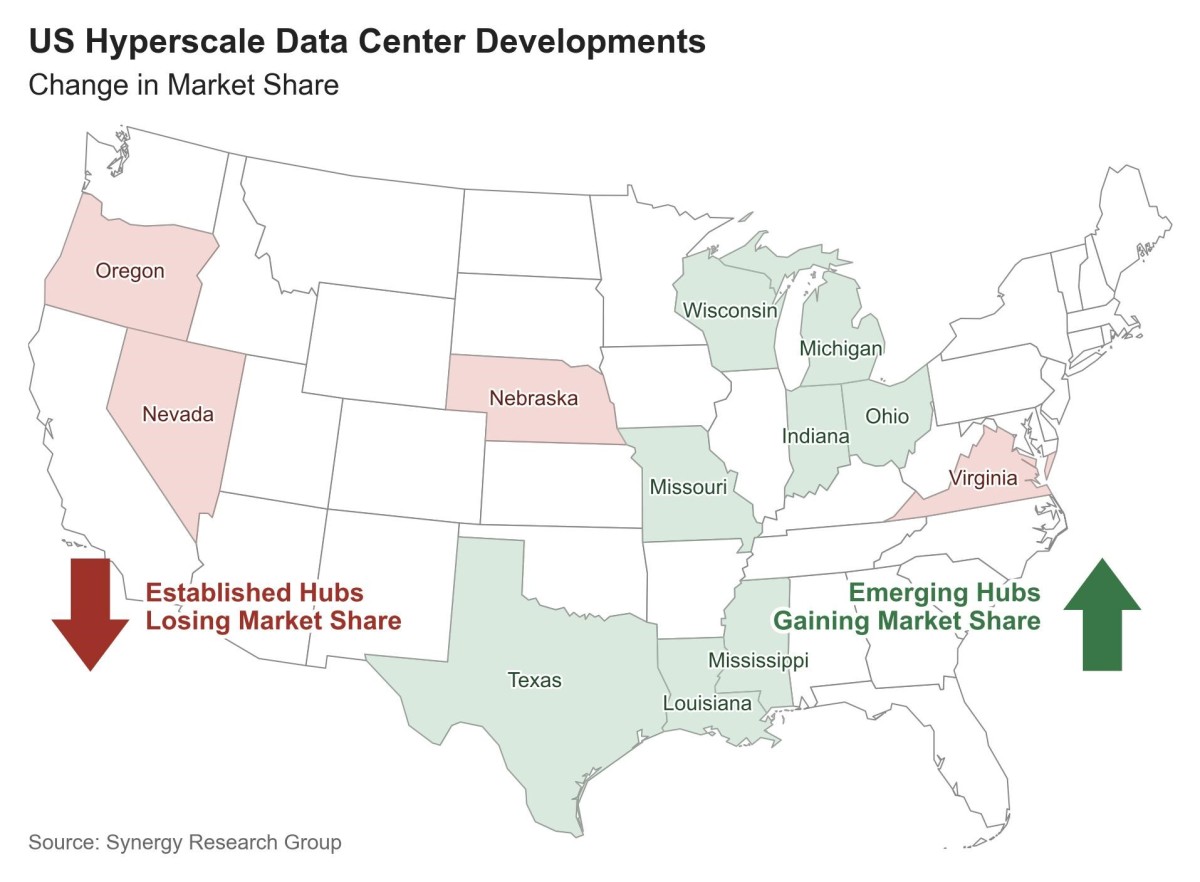
Recent data shows a shift in the US hyperscale data centre landscape. While development was traditionally concentrated in coastal regions, current and planned investment is increasingly moving towards central areas of the country. States such as Texas and several Midwestern states are seeing a growing share of activity. By the end of 2025, these regions accounted for 33% of US operational hyperscale data centre capacity.
Looking ahead, the pipeline for future hyperscale facilities is more concentrated in Texas and the Midwest, which are projected to represent 53% of new capacity. This trend is linked to rising infrastructure demand driven by artificial intelligence, alongside considerations such as access to power availability. Texas is a key location in this shift, whilst Wisconsin, Indiana, Michigan, and Missouri are emerging as growing data centre hubs, with investment from major technology companies including Amazon, Google, and Microsoft.
The analysis is based on data centre footprints and expansion plans from 21 major cloud and internet service providers. There are currently around 1,360 operational hyperscale data centres globally, with 580 located in the United States. The future pipeline includes 803 additional hyperscale facilities worldwide, of which 437 are expected to be in the US. Although the number of planned facilities is lower than existing operations, the projected capacity is higher, reflecting larger and more capable infrastructure designs.
Major cloud providers Amazon, Microsoft, and Google operate some of the largest hyperscale data centre networks globally. Together, they account for around 58% of total hyperscale data centre capacity, with operations spanning multiple regions internationally. This distribution reflects ongoing changes in infrastructure planning and responses to capacity and resource constraints.