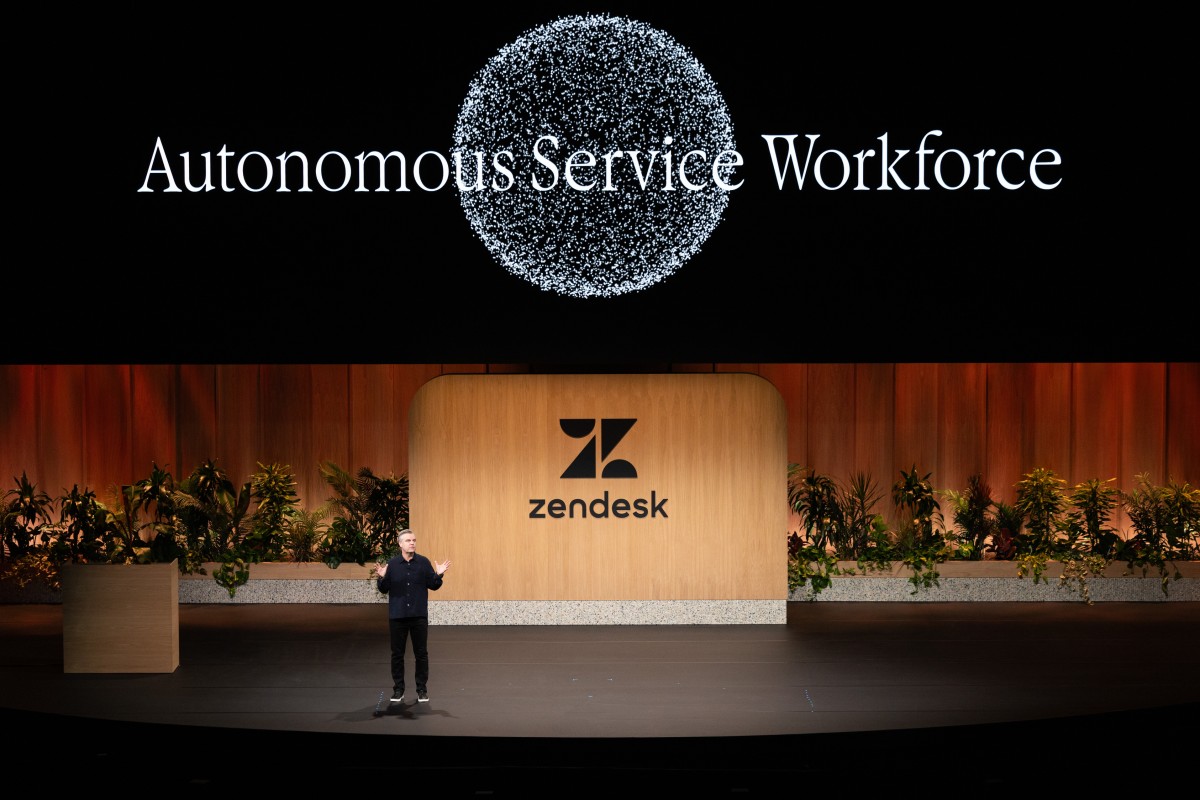
The Zendesk event in Colorado opened this week with a keynote from CEO Tom Eggemeier, setting the tone for the company’s vision for the future of customer experience. The session showcased Zendesk’s latest product announcements, with a strong focus on its evolving AI capabilities and the launch of an autonomous service workforce designed to support how businesses deliver customer service at scale.
Eggemeier spoke candidly about Zendesk’s evolution, positioning the company as one that is adapting alongside the changing demands of customer experience and AI-driven service. Reflecting on that journey, he noted that the platform has evolved from a single-threaded product to a full platform for customers to benefit from.
Throughout the event, Zendesk emphasised how AI is accelerating operational velocity, enabling teams to build, deploy, and scale new capabilities with greater speed and efficiency. Shashi Upadhyay, President of Product, Engineering, and AI at Zendesk, described this shift as the new industry standard: “Speed and agility are now the baseline”.
Managing the tension between AI scale and human experience
A central theme throughout the conference was how organisations can balance the speed and scale of agentic AI with strong customer and employee experiences. While AI is accelerating workflows and operational efficiency, Zendesk repeatedly emphasised that the technology must ultimately improve service quality, reduce friction for employees, and support more meaningful customer interactions.
Discussions also explored how rising customer expectations, demand for personalisation, and proactive service are reshaping customer experience strategies. AI-driven learning loops and autonomous systems are enabling organisations to anticipate customer needs faster, while aiming to help teams operate more efficiently and deliver more responsive support at scale.
At the same time, speakers highlighted that strategic direction still requires human judgement and nuance, particularly when navigating complex, fast-moving environments where competing priorities must be carefully balanced.
Trust as a competitive differentiator
A key theme throughout the event was trust, positioned as a core differentiator in an increasingly crowded market. Trust was framed as the result of multiple reinforcing layers across the platform, people, and governance model. At the platform level, Zendesk emphasised an open data system and knowledge graph approach designed to support large-scale automation.
An end-to-end platform strategy was also highlighted, integrating knowledge bases, customer workflows, and a marketplace of over 1,000 certified applications, supporting strong ecosystem growth and adoption. On the commercial side, AI is a major growth driver, with a target of $450 million in AI ARR this year, described as entirely new product-led revenue.
Trust was also explored through a regional lens, particularly in EMEA, where data sovereignty, privacy expectations, and governance requirements are shaping deployment decisions. These considerations were positioned as central to how organisations evaluate and adopt AI-enabled platforms, with compliance and control increasingly influencing technology choices as much as functionality. In this context, trust was framed not as a single requirement, but as an ongoing condition of deployment, shaped by transparency, regulatory alignment, and the ability to operate consistently across different markets.
Resilience and leadership with Simone Biles
Alongside the product announcements and AI strategy discussions, Relate 2026 also focused heavily on leadership, resilience, and the human side of transformation.
Olympic gymnast Simone Biles took part in an interview session centred on resilience, leadership, breaking barriers, and mental health. Reflecting on her personal journey, Biles discussed the pressures of performing at the highest level while maintaining wellbeing and confidence under intense public scrutiny.
The conversation focused on the importance of resilience during periods of uncertainty and change, as well as the role support systems play in sustaining long-term performance. The session provided a more personal counterpoint to the event’s wider focus on automation and AI, reinforcing the idea that organisational transformation still depends heavily on people, culture, and leadership.
Visionary leaders keynote
Leadership and transformation remained central themes throughout the event’s visionary leaders keynote sessions, where speakers explored how organisations are adapting to rapid AI-driven change.
Rob Giglio, Chief Customer Officer at Canva, discussed the complexity of supporting the company’s 250 million active monthly users. He argued that delivering customer experience at scale depends on more than automation alone, stating that it “takes smart systems, great workflows and really great processes”.
Giglio described customer resolution as a strategic priority and referenced a broader shift towards what he called “SaIS”, or Software as Intelligent Service, where customer relationships, tone, and sentiment remain central to service delivery.
Andre Heller, Signpost Project Director, reflected on the operational realities of rebuilding organisations during the age of AI. His session focused on consolidating technology teams, navigating acquisitions, and reshaping operations during periods of rapid change. He acknowledged the difficulty of moving away from long-established structures and emphasised the importance of choosing people who “share your values and conviction”.
Deon Nicholas, Co-founder and Executive Chairman of Forethought, focused on adaptability and organisational humility during periods of exponential AI growth. Encouraging businesses to “kill your golden cows”, Nicholas argued that organisations must avoid allowing previous success to become a barrier to future progress. Reflecting on Forethought’s experience, he said: “I didn’t want the very thing that made us successful being the thing to hold us back”.
Nicholas also warned against adopting technology without strategic direction. “Speed without direction is just chaos,” he said, while encouraging leaders to “lead with curiosity not ego”.
Across the keynote sessions, speakers repeatedly returned to the idea that successful transformation requires more than technology implementation alone. As one keynote message concluded: “True transformational success takes trust, collaboration and courage”.
MSP Channel Insights interviews and industry insights
At Zendesk Relate 2026, MSP Channel Insights spoke with multiple Zendesk executives, offering a broader view into different parts of the business and how each function is responding to AI-driven change, from customer experience and employee service to marketing strategy.
Matthias Goehler, CTO EMEA, focused on digitalisation pressures, multi-channel experience, and the need to balance automation with governance, privacy, and human decision-making in service delivery. He emphasised Zendesk’s automation direction across customer interactions, noting: “The big goal that our customers are working towards is automation. We believe we can automate up to eighty percent of all interactions, and that is also true across all the different channels.”
Emma Acton, VP Marketing EMEA, discussed evolving enterprise marketing priorities, including account-based marketing, localisation across EMEA, and the challenge of measuring multi-touch customer journeys in an AI-driven environment. Acton emphasised that “it’s incredibly important that you actually start from the brand itself and that you drive that demand through a brand-led motion first, so that people understand who you are as an organisation and what you stand for.”
Vishnu Parimi, VP Employee Service, explored changing employee expectations and the growing connection between employee and customer experience, with emphasis on AI-driven self-service, operational efficiency, and tighter integration across workplace systems. Commenting on employee satisfaction, Parimi stated: “If you're not keeping your employees happy, they leave and, as a result, there is a lot of churn. In this fast-moving world, you don't want to lose talent.”